


Default
Door Remote - 25 Sep 2026
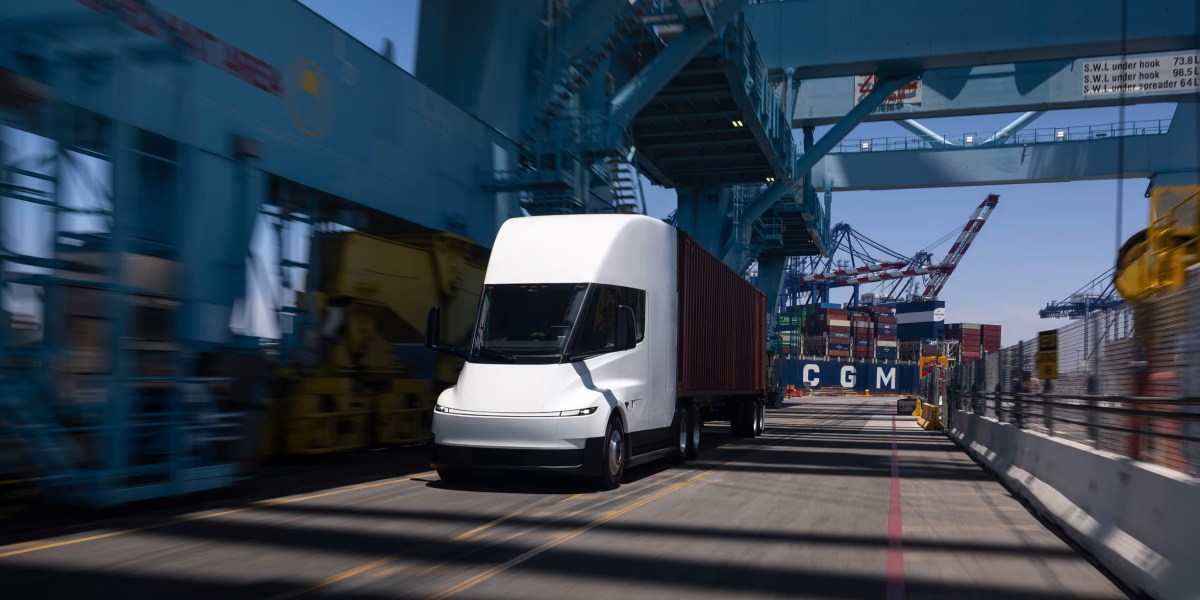
Tesla is finally handing over the first of its all-electric Semi trucks to customers after nearly a decade of delays and refinements to the vehicle, which it first revealed in 2017.
Company executives — except CEO Elon Musk, who was at President Trump’s state dinner with Chinese Premier Xi Jinping — walked an audience of customers, employees, and influencers through many of the details at an event in Reno, Nevada, on Thursday night.
Customers will be able to take delivery of the truck whenever they are ready, though charging infrastructure remains a hurdle, a person familiar with the matter told TechCrunch on the condition of anonymity.
Without revealing the final sticker price, the executives promised the truck will help fleet owners lower their total cost of ownership, reduce emissions, and benefit from greater reliability.
The event was held at a new factory dedicated to the Semi that’s adjacent to the company’s first Gigafactory in Reno. Tesla plans to build as many as 50,000 trucks a year at the plant, or roughly 1,000 per week, and create 3,000 jobs for the local economy. The most capable version of the truck is expected to travel 500 miles or more on one charge (depending on the size of the load) and cost just shy of $300,000 before incentives. There will be shorter-range variants, too.
The Semi’s long-awaited launch comes at a time of transition for Tesla. Musk now paints Tesla as a robotics and AI company even though nearly all of its revenue comes from vehicle sales. He has also changed Tesla’s mission to “build a world of amazing abundance.” When he showed off the Semi in 2017, Tesla’s mission was still “to accelerate the world’s transition to sustainable energy.”
Despite the change in positioning, and seemingly priorities for Tesla, Thursday’s event still saw a lot of discussion about reducing trucking emissions. Dan Priestley, the head of Tesla’s Semi program, noted that heavy trucks produce 16% of emissions despite making up just 1% of vehicles on the road.
“We’re super excited to be deploying these into our own operations because it’s fulfilling the mission that we originally started out [with],” he said.
“Occasionally we get a little too far out there”
Originally slated to go into production in 2019, the Semi was delayed for multiple reasons. The pandemic, a global parts supply and semiconductor shortage, and changes made in response to pilot customer feedback all contributed to the years-long wait.
Priestley and Lars Moravy, who leads most of Tesla’s engineering efforts, detailed many of those changes during the 30-minute event — timed thus to show a Semi that started at 3% battery go up to 60% while plugged into one of Tesla’s megawatt charging stations. (Tesla is also building an entire network of these chargers, which Priestley detailed during the event.)
Some of these changes are big and obvious: The company has shaved off roughly 1,000 pounds of weight from the vehicle compared to its original version. Others are more specific, like going from using three different oils in the Semi’s drive axle to just one.
Moravy said the previous axle design that needed three different oils had “always frustrated” him, and admitted that Tesla tends to prioritize “super bespoke” designs. Priestley added that changes to the motor design and work from Tesla’s lubricants team allowed the company to cut out the other two oils. “Occasionally we get a little too far out there,” he said.
Tesla also had to pivot to fix issues with the side windows. In its original design, the company employed pop-out windows that didn’t fully open, and for years, everyone from actual truck drivers to automotive bloggers raised this as an obvious problem.
On Thursday, Priestley offered a mea culpa. He called the original design “not sufficient” and revealed that the new Semi now has standard roll-down windows.
“We fully admit we were wrong about the windows,” he said. “Turns out there’s a lot of infrastructure in the world, whether it’s a badge reader, or your toll booth, or you’re talking to somebody on a call box. There’s all kinds of stuff right at that height, and it became evident that we needed a roll-down window in order to make that infrastructure easier to interface with.”
“It’s okay to be wrong, Dan,” Moravy added.
But Tesla appears to have been right with its goal of making a truck that travels 500 miles on a single charge while fully loaded.
That claim, which Musk made during the original event in 2017, was a source of much derision for years. One of his highest-profile doubters was Bill Gates, who wrote in a 2020 blog post that electric big rigs would “probably never be a practical solution” because “batteries are big and heavy.”
Without naming him, Moravy and Priestley poked fun at Gates onstage during Thursday’s event: “We’re kind of ruthless about every watt-hour that we chase in these things, because there’s this wonderful compounding effect, [which] is that if you make the vehicle more efficient, that means it’s less battery you need to do the same amount of work, which means that you can take battery out of the vehicle, which is lower cost and lower mass,” Priestley said.
“We had some naysayers, names shall not be mentioned,” Moravy followed.
“But, pretty well-known names,” Priestley responded.
“And at Tesla, we love when people tell us something’s impossible. So we took that challenge,” Moravy said.
While Musk was missing, he did pre-tape a segment that ran before the event started. In the video, he said the Semi will be the “funnest truck to drive.” He also promised Tesla’s partial automation features (curiously missing from the Semi despite the years of delays) will be added in the “near future.”
Musk also pitched the truck as making “a ton of sense economically, because the cost of electricity per mile is much less than the cost of diesel, especially in these crazy times” — though that final clause conveniently glosses over the fact that diesel prices have shot up because the president Musk himself helped elect has started a war that’s roiled energy markets.
Company executives — except CEO Elon Musk, who was at President Trump’s state dinner with Chinese Premier Xi Jinping — walked an audience of customers, employees, and influencers through many of the details at an event in Reno, Nevada, on Thursday night.
Customers will be able to take delivery of the truck whenever they are ready, though charging infrastructure remains a hurdle, a person familiar with the matter told TechCrunch on the condition of anonymity.
Without revealing the final sticker price, the executives promised the truck will help fleet owners lower their total cost of ownership, reduce emissions, and benefit from greater reliability.
The event was held at a new factory dedicated to the Semi that’s adjacent to the company’s first Gigafactory in Reno. Tesla plans to build as many as 50,000 trucks a year at the plant, or roughly 1,000 per week, and create 3,000 jobs for the local economy. The most capable version of the truck is expected to travel 500 miles or more on one charge (depending on the size of the load) and cost just shy of $300,000 before incentives. There will be shorter-range variants, too.
The Semi’s long-awaited launch comes at a time of transition for Tesla. Musk now paints Tesla as a robotics and AI company even though nearly all of its revenue comes from vehicle sales. He has also changed Tesla’s mission to “build a world of amazing abundance.” When he showed off the Semi in 2017, Tesla’s mission was still “to accelerate the world’s transition to sustainable energy.”
Despite the change in positioning, and seemingly priorities for Tesla, Thursday’s event still saw a lot of discussion about reducing trucking emissions. Dan Priestley, the head of Tesla’s Semi program, noted that heavy trucks produce 16% of emissions despite making up just 1% of vehicles on the road.
“We’re super excited to be deploying these into our own operations because it’s fulfilling the mission that we originally started out [with],” he said.
“Occasionally we get a little too far out there”
Originally slated to go into production in 2019, the Semi was delayed for multiple reasons. The pandemic, a global parts supply and semiconductor shortage, and changes made in response to pilot customer feedback all contributed to the years-long wait.
Priestley and Lars Moravy, who leads most of Tesla’s engineering efforts, detailed many of those changes during the 30-minute event — timed thus to show a Semi that started at 3% battery go up to 60% while plugged into one of Tesla’s megawatt charging stations. (Tesla is also building an entire network of these chargers, which Priestley detailed during the event.)
Some of these changes are big and obvious: The company has shaved off roughly 1,000 pounds of weight from the vehicle compared to its original version. Others are more specific, like going from using three different oils in the Semi’s drive axle to just one.
Moravy said the previous axle design that needed three different oils had “always frustrated” him, and admitted that Tesla tends to prioritize “super bespoke” designs. Priestley added that changes to the motor design and work from Tesla’s lubricants team allowed the company to cut out the other two oils. “Occasionally we get a little too far out there,” he said.
Tesla also had to pivot to fix issues with the side windows. In its original design, the company employed pop-out windows that didn’t fully open, and for years, everyone from actual truck drivers to automotive bloggers raised this as an obvious problem.
On Thursday, Priestley offered a mea culpa. He called the original design “not sufficient” and revealed that the new Semi now has standard roll-down windows.
“We fully admit we were wrong about the windows,” he said. “Turns out there’s a lot of infrastructure in the world, whether it’s a badge reader, or your toll booth, or you’re talking to somebody on a call box. There’s all kinds of stuff right at that height, and it became evident that we needed a roll-down window in order to make that infrastructure easier to interface with.”
“It’s okay to be wrong, Dan,” Moravy added.
But Tesla appears to have been right with its goal of making a truck that travels 500 miles on a single charge while fully loaded.
That claim, which Musk made during the original event in 2017, was a source of much derision for years. One of his highest-profile doubters was Bill Gates, who wrote in a 2020 blog post that electric big rigs would “probably never be a practical solution” because “batteries are big and heavy.”
Without naming him, Moravy and Priestley poked fun at Gates onstage during Thursday’s event: “We’re kind of ruthless about every watt-hour that we chase in these things, because there’s this wonderful compounding effect, [which] is that if you make the vehicle more efficient, that means it’s less battery you need to do the same amount of work, which means that you can take battery out of the vehicle, which is lower cost and lower mass,” Priestley said.
“We had some naysayers, names shall not be mentioned,” Moravy followed.
“But, pretty well-known names,” Priestley responded.
“And at Tesla, we love when people tell us something’s impossible. So we took that challenge,” Moravy said.
While Musk was missing, he did pre-tape a segment that ran before the event started. In the video, he said the Semi will be the “funnest truck to drive.” He also promised Tesla’s partial automation features (curiously missing from the Semi despite the years of delays) will be added in the “near future.”
Musk also pitched the truck as making “a ton of sense economically, because the cost of electricity per mile is much less than the cost of diesel, especially in these crazy times” — though that final clause conveniently glosses over the fact that diesel prices have shot up because the president Musk himself helped elect has started a war that’s roiled energy markets.