


Default
Door staff@engadget.com (Cherlynn Low) - 08 Oct 2026
Amazon has been hard at work, releasing new device after new device, week after week. As part of the introduction of the Alexa Tablet series announced today, the company's Senior Vice President of Devices and Alexa, Panos Panay, sat with a small group of reporters. In answering our questions, Panay teased new products and design paradigms coming from the company.
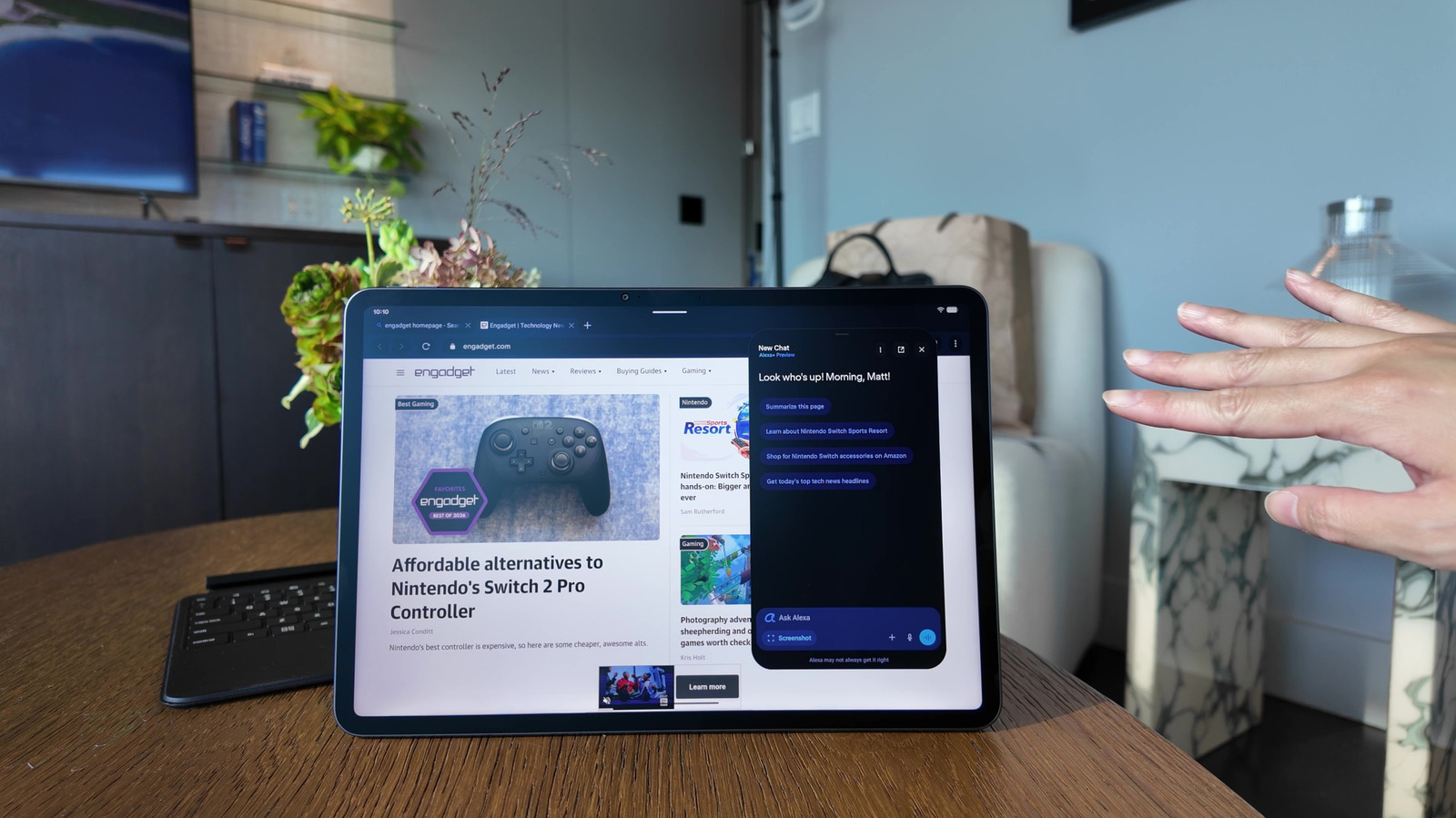
The new Alexa Tablet series replaces the popular Fire tablet family, and places the company's AI assistant front and center. To my knowledge, it was the first hardware product by Amazon with Alexa as its brand, so I asked Panay to confirm. I ran through a list of Amazon product names. from Echo, Fire TV and Kindle, to Ring, Blink and Eero, even considering the now-defunct Halo brand.
Panay responded in the affirmative, so I asked if the Alexa tablet series was the beginning of a push into more hardware with the AI's name attached. Panay first said "No, it's just when it makes sense," before later saying coyly, "not that you've seen."
It's pretty typical for any company of Amazon's size to have plenty of prototypes and concepts floating around in multiple R&D labs worldwide, and for any number of them to bear the Alexa moniker is just as likely. Panay has said to me before that there's probably a foldable Kindle in experimental form somewhere, too. His response here did not reveal much.
But then I asked what I thought was a more specific, technical question about whether there was a name for the software interface that adds the Alexa layer to the tablets' Android operating systems. He replied saying this:
"Ralf [Groene, who leads design for Amazon Devices & Services] is developing what he calls a Neo design language. We don't talk about it, I'm not sure I should've said that out loud. It is Neo."
Setting aside the fact that tech companies really need to find other sources of inspiration for the names of their products, this is certainly something more tangible. Of all the hardware brands Amazon has highlighted so far in the last few weeks, the Echo speakers and displays have yet to get their moment in the limelight. Panay indicated that he would be back later this month to share more on that brand as well as Neo.
He didn't reveal too much more about the Neo "design language," but did describe it as a "structure of how we're moving information. Not seeing it, but moving it to the customer in ways that they can get back to it, depending on where they are."
Panay described a challenge he believes people are facing with the rise of disparate AI agents and apps. "One of the things that's happening is, the connection between all these products — especially with your AI interface — you're starting to see it's getting bifurcated. You go into too many different places and you don't remember where you were, it's getting tricky for people."
He explained that, say you solved a problem in a certain app. Then you got an answer to a different problem in another app. Then you see a new app and decide to try it out. Suddenly, remembering where the answer to one of those questions gets trickier.
"We have this frame that's meant to connect it all simply. I'm giving away a little too much," he said before promising to share more at the end of the month.
Based on my understanding of the Alexa tablets' interface so far, plus my interpretation of Panay's mysterious language, it seems that Amazon is preparing to introduce a cross-device ecosystem with Alexa at its core.
It's not hard to see how this would work, and in a way the breadcrumb trail has already been laid. The company's Ember Artline Fire TV can understand where you've paused a show on Prime Video in one room. When you go to another room and ask Alexa to resume, it can pick back up on a TV in there.
Similarly, the new Alexa tablets can continue conversations you started on your Echo Show, for instance. And thanks to the Alexa app, which works on iOS, Android and the web, there's a fairly easy way for Amazon to digitally follow your mental journey.
The company's "About You" dossiers went under the radar when they were announced in May, but lately started gaining widespread attention on social media after some users found it had come up with hilarious deductions about themselves. About You is still a feature in beta, just as Alexa+ remains in "preview."
With new Echo products on the horizon, the smart home category seems poised for big news. Apple is reportedly hosting an event in October to unveil a new smart home ecosystem including a lock, thermostat and a smart home camera, all with Siri AI at the core. The company is rumored to have been working with home appliance giant LG on these products.
Meanwhile, Google has slowly but surely been inserting its Gemini AI into all its products, including its speakers, TVs, thermostats, cameras and more.
Amazon has long been in the smart home space and arguably has the advantage there. Alexa and the Echo speaker are considered pioneers in their respective categories. It would certainly be intriguing to see how Amazon plans to juice them up to take on the competition, which, from Apple, would certainly be formidable.
The new Alexa Tablet series replaces the popular Fire tablet family, and places the company's AI assistant front and center. To my knowledge, it was the first hardware product by Amazon with Alexa as its brand, so I asked Panay to confirm. I ran through a list of Amazon product names. from Echo, Fire TV and Kindle, to Ring, Blink and Eero, even considering the now-defunct Halo brand.
Panay responded in the affirmative, so I asked if the Alexa tablet series was the beginning of a push into more hardware with the AI's name attached. Panay first said "No, it's just when it makes sense," before later saying coyly, "not that you've seen."
It's pretty typical for any company of Amazon's size to have plenty of prototypes and concepts floating around in multiple R&D labs worldwide, and for any number of them to bear the Alexa moniker is just as likely. Panay has said to me before that there's probably a foldable Kindle in experimental form somewhere, too. His response here did not reveal much.
But then I asked what I thought was a more specific, technical question about whether there was a name for the software interface that adds the Alexa layer to the tablets' Android operating systems. He replied saying this:
"Ralf [Groene, who leads design for Amazon Devices & Services] is developing what he calls a Neo design language. We don't talk about it, I'm not sure I should've said that out loud. It is Neo."
Setting aside the fact that tech companies really need to find other sources of inspiration for the names of their products, this is certainly something more tangible. Of all the hardware brands Amazon has highlighted so far in the last few weeks, the Echo speakers and displays have yet to get their moment in the limelight. Panay indicated that he would be back later this month to share more on that brand as well as Neo.
He didn't reveal too much more about the Neo "design language," but did describe it as a "structure of how we're moving information. Not seeing it, but moving it to the customer in ways that they can get back to it, depending on where they are."
Panay described a challenge he believes people are facing with the rise of disparate AI agents and apps. "One of the things that's happening is, the connection between all these products — especially with your AI interface — you're starting to see it's getting bifurcated. You go into too many different places and you don't remember where you were, it's getting tricky for people."
He explained that, say you solved a problem in a certain app. Then you got an answer to a different problem in another app. Then you see a new app and decide to try it out. Suddenly, remembering where the answer to one of those questions gets trickier.
"We have this frame that's meant to connect it all simply. I'm giving away a little too much," he said before promising to share more at the end of the month.
Based on my understanding of the Alexa tablets' interface so far, plus my interpretation of Panay's mysterious language, it seems that Amazon is preparing to introduce a cross-device ecosystem with Alexa at its core.
It's not hard to see how this would work, and in a way the breadcrumb trail has already been laid. The company's Ember Artline Fire TV can understand where you've paused a show on Prime Video in one room. When you go to another room and ask Alexa to resume, it can pick back up on a TV in there.
Similarly, the new Alexa tablets can continue conversations you started on your Echo Show, for instance. And thanks to the Alexa app, which works on iOS, Android and the web, there's a fairly easy way for Amazon to digitally follow your mental journey.
The company's "About You" dossiers went under the radar when they were announced in May, but lately started gaining widespread attention on social media after some users found it had come up with hilarious deductions about themselves. About You is still a feature in beta, just as Alexa+ remains in "preview."
With new Echo products on the horizon, the smart home category seems poised for big news. Apple is reportedly hosting an event in October to unveil a new smart home ecosystem including a lock, thermostat and a smart home camera, all with Siri AI at the core. The company is rumored to have been working with home appliance giant LG on these products.
Meanwhile, Google has slowly but surely been inserting its Gemini AI into all its products, including its speakers, TVs, thermostats, cameras and more.
Amazon has long been in the smart home space and arguably has the advantage there. Alexa and the Echo speaker are considered pioneers in their respective categories. It would certainly be intriguing to see how Amazon plans to juice them up to take on the competition, which, from Apple, would certainly be formidable.